The Genius of the Bur Changes Everything
Leggi in Italiano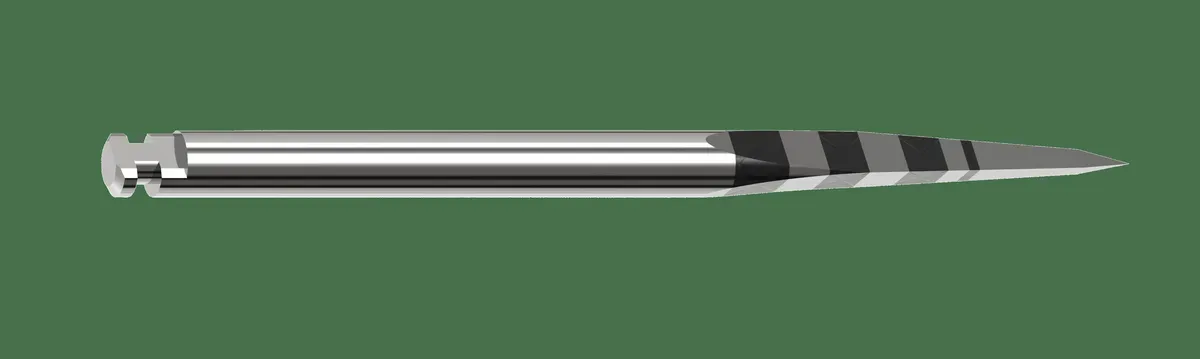
In brief — The modified Bonebenders lancet bur solves critical implantology challenges: correcting implant trajectories, preparing interradicular septa, and accessing the maxillary sinus without trauma. A single instrument combining precision, control, and gentleness—essential for guided bone regeneration.
not since the days of Longinus has there been a bur quite like this!
Dear colleague,
Do you struggle to keep the prosthetic axis correct during the osteotomy for your implants?
Have you ever had trouble correcting the position of an implant relative to the socket in an immediate post-extraction case?
Have you ever struggled to place an immediate post-extraction implant in the bony septum of a molar?
Have you ever found it hard to cross the cortex of the maxillary sinus without damaging it, to do a “mini-lift”?
Do you consider yourself excellent, yet your patients can’t bear the “hammering” and won’t let you work the way you’d like?
Have you tried with the utmost gentleness and every modern instrument, but to your patients you’re always Thor with his hammer?

If you recognise yourself in these sentences, read on—because you’ve just solved these problems…
You’re not alone.
EVERYONE has these problems, and they’re problems that could compromise the result.
But now you don’t have to worry, because there’s a solution, and it is… simple!
That’s why the instrument we’re about to discuss in these lines came to be.
In every implant kit, in various forms, there’s a pointed bur, or “lance” bur, a fundamental instrument in classic implantology used to make the initial hole…
…but the modified version developed for the Bonebenders kit introduces innovative features that significantly amplify its clinical potential.
This bur stands out for its wider profile compared with traditional versions, with a more pronounced progressive taper starting from the tip.
Distinctive Technical Features
Innovative Design
The main innovation of this lancet bur lies in its modified geometry. Unlike conventional lancet burs, this version presents:
- Expanded profile: greater taper width from the tip
- Gradual transition: progressive expansion that makes intraoperative control easier
- Coloured depth bands: for precise, controlled preparation (much like other implant burs)
Creating the Guided Path
The modified lancet bur is the first instrument used in the Bonebenders protocol. Its primary function is to create the initial path that will then be followed throughout the preparation of the implant site.
The cortical bone walls act as a natural guide, ensuring that the bur, at low speed:
- Has directional precision that follows the medullary bone, even when it is scarcely represented
- Stays safe, avoiding fenestration of the cortex
- Allows continuous, total control of the preparation along its full length
Let’s revisit the opening questions:
“Have you ever had trouble correcting the position of an implant relative to the socket in an immediate post-extraction case?”
Correcting the Implant Path
One of the most significant applications concerns correcting compromised implant trajectories. When residual dental sockets threaten to deflect the implant toward an inadequate position (typically too buccal), this bur lets you:
- Modify the implant path precisely, like a pen
- Change direction entirely relative to the socket
- Avoid anatomical interferences
- Re-establish an ideal implant axis
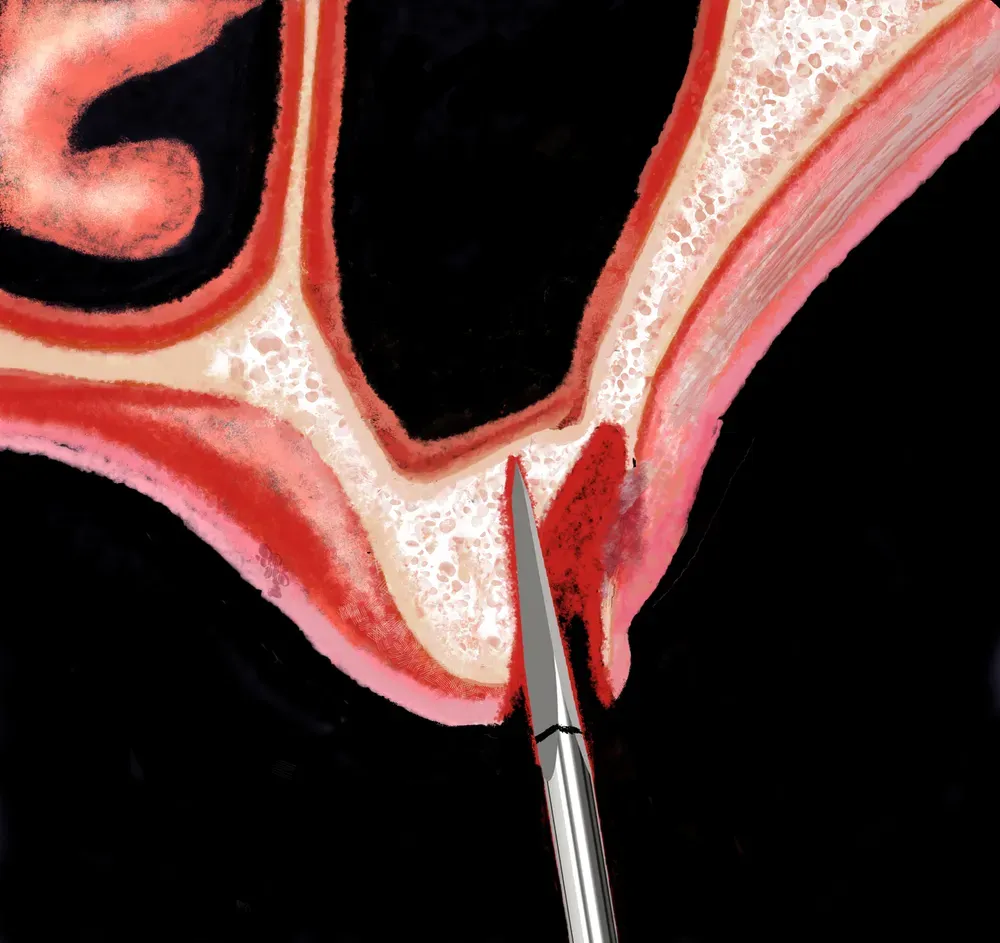
It is also good practice (and an integral part of the protocol) to verify the bur’s initial path radiographically as well.
“Have you ever struggled to place an immediate post-extraction implant in the bony septum of a molar?”
3. Preparing the Interradicular Septa
In posterior implant rehabilitation with reduced interradicular spaces, the modified lancet bur is the first preparatory step, after (gentle) extraction:
- Initial phase: creation of the primary implant site
- Engaging the residual septal bone, even when it’s pointed and therefore not easy to engage for the initial osteotomy
- Preparing for expanders: setting up for the subsequent use of expander instruments
- Optimising space: making the most of the available bone, both in height and in three-dimensional position and prosthetic axis
“Have you ever found it hard to cross the cortex of the maxillary sinus without damaging it, to do the ‘mini-lift’?”
Accessing the Maxillary Sinus
In maxillary sinus lift procedures, this bur plays a crucial role—one that is hard to explain to anyone who has never done it, yet simple and safe to carry out “in the field”:
Controlled Cortical Perforation of the Sinus
In cases of posterior maxillary crestal bone with inadequate consistency or with heterologous grafts.
- Creating precise access to engage the sinus cortex with the expanders
- Minimising the risk of accidental perforation, thanks to the pinpoint tip and the intrinsic elasticity of the ciliated respiratory mucosa
- Preparing for the insertion of the expanders
Guided Lift Technique
This happens when the bur lets you recover bone along the sides of the maxillary antrum relative to the correct prosthetic position. You often see cases labelled atrophic that aren’t really that atrophic. You have to work in three dimensions. Often a low maxillary sinus conceals a lateral wall that is perfectly usable to move existing bone and achieve a perfect crestal lift in little time and without biomaterials.
- Identify areas of more consistent bone (for example in the palatal zone)
- Guide the direction of the lift toward those areas
- Prepare the site for controlled bone expansion
And recent literature confirms the course is right. The meta-analysis by Kadkhodazadeh and colleagues (British Journal of Oral & Maxillofacial Surgery, 2024) pooled the studies on crestal sinus lift and found a 100% implant survival rate—identical with or without graft. The same message comes from Tent and colleagues (Medicina, 2025): at three and five years, lifting with osteotomes without biomaterials holds up as well as with heterologous bone, with comparable survival and marginal bone loss. I’ve been saying it for years; now there’s a number beside the experience. Often the graft is a complication we add ourselves.
There is, however, a caveat—and it’s written into the data itself. Kadkhodazadeh notes that it’s the hand osteotomes—the “hammering”—that raise the risk of membrane perforation and post-operative vertigo. That is exactly the limit the tip of the modified lancet bur sidesteps: you enter accompanying the cortex, not pounding it. And when trauma drops, the patient feels it: the review by Menini and colleagues (International Journal of Oral & Maxillofacial Implants, 2025) shows that the crestal, graftless approach hurts less, with lower pain in the first seven days. That’s what we’re after when we want a transcrestal sinus lift the patient barely notices, or a clean immediate post-extraction placement.
Operative Precision
Clinical Advantages of the Modified Lancet Bur
The modified design guarantees:
- Superior control of position and path during preparation
- Reduced risk of unwanted deviations
- Greater predictability of the final osteotomy result
Versatility of Use
A single instrument for multiple applications:
- Standard preparation
- Trajectory correction
- Access to complex anatomical zones
- Preparation for advanced procedures, such as ridge widening
Procedural Efficiency
- Reducing the number of instruments needed
- Simplifying the operative protocol
- Optimising surgical times
“Do you consider yourself excellent, yet your patients can’t bear the ‘hammering’ and won’t let you work the way you’d like?” “Have you tried with the utmost gentleness and every modern instrument, but to your patients you’re always Thor with his hammer?”
The Efficiency of the Bonebenders Kit for Gentle Osteo-mucosal Expansion
The modified lancet bur is the first instrument in the series: it enables the use of the expanders which, in turn, achieve regeneration in an absolutely non-traumatic way.
Considerations on Primary Stability
The correct use of the modified lancet bur directly influences the primary stability of implants, a fundamental element for osseointegration success. Precise preparation of the implant site lets you optimise bone-to-implant contact from the very first moments.
Here too, the data accompanies the gesture. The meta-analysis by Starch-Jensen and colleagues (Journal of Oral & Maxillofacial Research, 2025) compared crestal techniques and saw that, when the site is prepared by densifying the bone rather than removing it, the ISQ—the instrumental measure of primary stability—rises significantly, both at implant placement and at abutment connection. Less trauma, however, also means less trouble: Cobo-Vázquez and colleagues (International Journal of Implant Dentistry, 2025) report a complication rate of 2.8% for the gentle crestal approach against 14.3% for the classic percussion osteotome. The modified lancet bur lives in this logic: it traces the path, compresses instead of digging, prepares the bone to hold.
Approaching Bone Deficits
In cases of horizontal bone deficits, the modified lancet bur is often the first step of a wider regenerative strategy, letting you assess and prepare the residual bone tissue for subsequent expansion or regeneration techniques.
Conclusions
The modified lancet bur of the Bonebenders kit represents a significant evolution of traditional implant instruments. Its versatility and optimised design make it an indispensable tool for modern implantology, particularly in complex cases that demand superior precision and control.
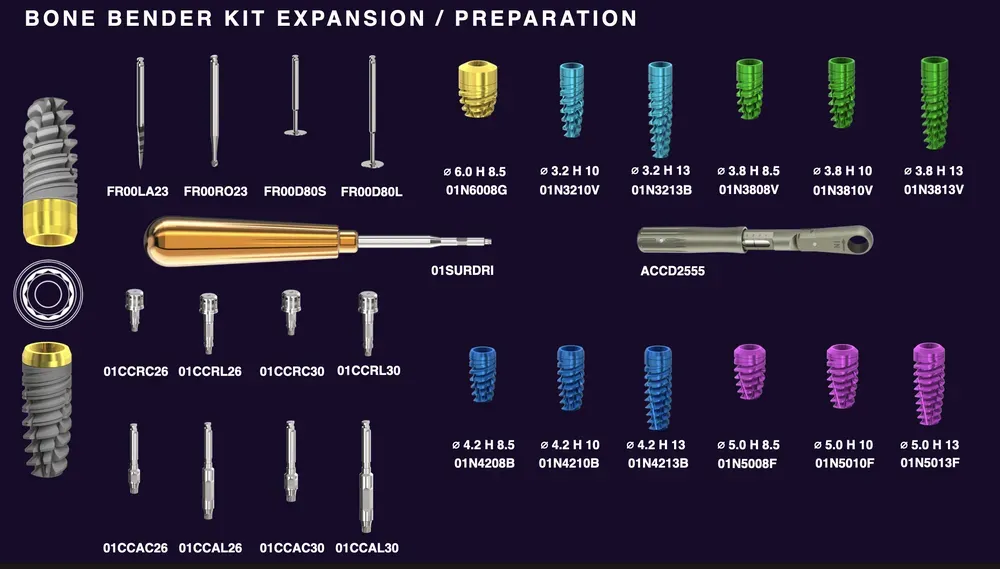
Integrating this instrument into surgical protocols allows you to face challenging clinical situations with greater safety, improving the predictability of results and operative efficiency. As shown in the second-intention healing techniques, the Bonebenders approach values the natural processes of tissue regeneration.
References
- Kadkhodazadeh M, Alimardani Y, Azadi A, Daneshvar A, Amid R, Khaleghi A. Clinical outcomes of implants placed with transcrestal maxillary sinus elevation: a systematic review and meta-analysis. Br J Oral Maxillofac Surg. 2024;62(8):685-703. DOI · PMID 39098575
- Tent AP, Țig IA, Bran S, Zlotu A, Mester A, Onisor F. Long-term effects of sinus floor elevation with and without bone graft: a systematic analysis of randomized clinical trials. Medicina (Kaunas). 2025;61(1):104. DOI · PMID 39859086
- Starch-Jensen T, Østergaard KB, Bruun NH, Shino IL, Hallund MH. Transcrestal maxillary sinus membrane elevation using osseodensification compared with alveolar ridge augmentation using the lateral window or osteotome technique: a systematic review and meta-analysis. J Oral Maxillofac Res. 2025;16(2):e1. DOI · PMID 40693126
- Menini M, Canullo L, Pesce P, Bixio F, Bagnasco F, Del Fabbro M. Patient-reported outcome measures (PROMs) in sinus lift procedures: a systematic review and meta-analysis. Int J Oral Maxillofac Implants. 2025 (Epub ahead of print). DOI · PMID 40553622
- Cobo-Vázquez CM, García-Rodríguez S, Colmenares-Otero ME, Sáez-Alcaide LM, Cortés-Bretón-Brinkmann J, Madrigal Martínez-Pereda C, et al. Clinical and radiographic evaluation for two crestal sinus lift techniques: osteotome versus osseodensification. A systematic review and meta-analysis. Int J Implant Dent. 2025;11(1):36. DOI · PMID 40377845
FAQ
Q: What are the main differences between the modified lancet bur and conventional lancet burs?
Q: Can the modified lancet bur resolve major bone deficits on its own?
Q: How important is rotation speed for using this instrument correctly?
Q: How does it help access the maxillary sinus without harming the membrane?
Q: Can this bur be used for sinus lift without biomaterials?
Q: Is primary stability guaranteed even in cases of bone deficit?
Cite this article
Ready for theses, slides and papers. If you cite it on a web page, make the URL a link so readers can reach the source.
Bruschi E. The Genius of the Bur Changes Everything [Internet]. Frosinone (Italy): Bonebenders; 2025 [updated 2026 Jun 22; cited 2026 Oct 25]. Available from: https://bonebenders.com/en/blog/modified-lancet-bur-implant-guide/ Bruschi, E. (2025, September 16). The Genius of the Bur Changes Everything. Bonebenders. https://bonebenders.com/en/blog/modified-lancet-bur-implant-guide/
@misc{bruschi2025modified,
  author       = {Bruschi, Ernesto},
  title        = {The Genius of the Bur Changes Everything},
  year         = {2025},
  month        = sep,
  howpublished = {Bonebenders},
  url          = {https://bonebenders.com/en/blog/modified-lancet-bur-implant-guide/},
  note         = {Accessed 2026-10-25}
} Go deeper
Espansione crestale (split crest) →Allargare la cresta senza trapianto — tecnica ERE e bonebending
Need a professional opinion?
Book an appointment at Dr. Bruschi's practice in Frosinone. First visit includes full diagnosis and personalised treatment plan.
Stai valutando un impianto dentale?
Ti hanno detto che non hai abbastanza osso, o ti hanno proposto un’arcata fissa? Ho scritto una guida di dieci pagine: le strade possibili, gli esami che servono e le dieci domande da fare prima di firmare.
Ricevi la guidaStay Updated
New articles on periodontology, implantology and oral surgery — delivered to your inbox.
Comments
Loading comments...
Leave a comment